AMERICAN WEDDINGS BLOG
Stay up to date with the latest wedding ceremony trends, script writing inspiration, tips and advice for first-time officiants, and news that matters to couples and wedding ministers.
Stay up to date with the latest wedding ceremony trends, script writing inspiration, tips and advice for first-time officiants, and news that matters to couples and wedding ministers.
Published Monday, Oct. 6th, 2025

Supreme Court Justice Clarence Thomas recently spoke at an event for Catholic University. During the event, Justice Thomas said that the Court should be thoughtful about ‘stare decisis,’ the legal principle that says ‘past legal decisions guide future legal decisions.’ If this doesn’t set off any alarm bells for you, I get it. But they should be ringing, especially with marriage equality in the spotlight right now.
Here’s why.
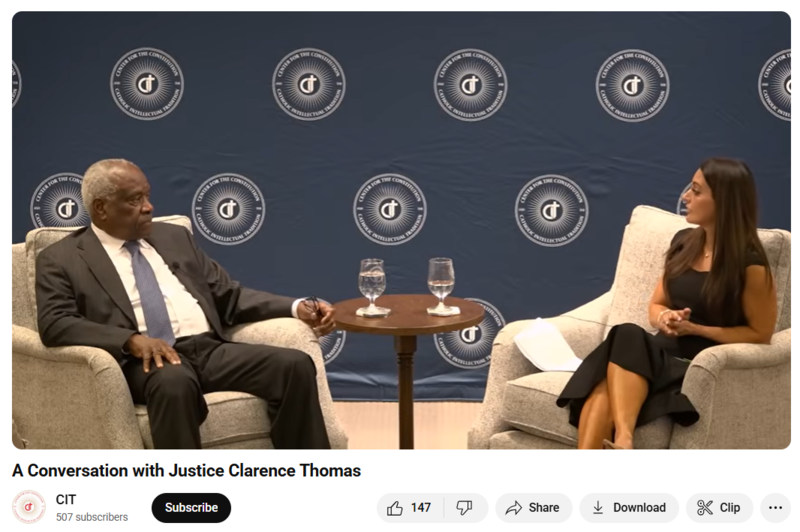
Above: Associate Justice Clarence Thomas speaking with Professor Jen Mascott, who has been nominated for the Third Circuit Court of Appeals, during a September 25th event for Catholic University’s Center for the Constitution and the Catholic Intellectual Tradition (CIT). Justice Thomas will be teaching a course at Catholic University’s Columbus School of Law in Washington, DC this semester, alongside Judge Gregory E. Maggs, from the Court of Appeals for the Armed Forces.
In the US, previous legal rulings are used as guidelines – or precedents – when deciding future rulings on similar topics. These precedents fueled the Civil Rights Movement; ensure your right to an attorney even if you can’t afford one; and protect the right to free speech for students; among many other examples. The principle of precedent is called 'stare decisis;' it's what keeps legislators and judges from needing to reinvent the wheel for every case, and helps our laws keep up with the progression of values and ideas over time.
As an illustration of how precedent and stare decisis work, consider Brown v. Board of Education, and the chain of events that followed: When this landmark case was decided in 1954, it established that racially segregating schools is unconstitutional. With this powerful precedent against segregation on the books, other areas of public life were also desegregated. When Loving v. Virginia was passed in 1967, Justices cited the precedent of racial equality established by Brown in their ruling in favor of interracial marriage. And when Obergefell v. Hodges was passed in 2015, recognizing marriage rights for same-sex couples, Justices cited the precedent set by Loving v. Virginia.
In this way, the Civil Rights Movement fought by Black Americans was instrumental in establishing marriage rights for LGBTQ+ Americans nearly sixty years later, with each new case serving as a building block toward equality, set upon a strong constitutional foundation.
This type of legal precedent is what Justice Thomas was referring to last month, when he said that stare decisis should be revisited if it “doesn’t make any sense.” Check it out (and if you’re watching the video below, this pops up around the 32 minute mark.):
Professor Mascott: “What factors do you bring when you write an opinion that suggests maybe a line of cases should be revisited?”
Justice Thomas: “Well, if I find it doesn’t make any sense. I think we should demand that no matter what the case is, that it has more than just a simple theoretical basis…
…I don’t think that I have the gospel and I don’t think that any of these cases that have been decided are the gospel. And I do give respect to precedent, but the precedent should be respectful of our legal tradition and our country and our laws. And be based on something, not just something that somebody dreamt up and others went along with. Let’s just take for example; do you think that Plessy was right? That was a precedent for what set almost seven decades...
At some point we need to think about what we’re doing with stare decisis. And it’s not some sort of talismanic deal where you can just say ‘stare decisis’ and not think, turn off the brain, right?”
Justice Thomas is making a strong point, and it’s a good one. After all, our earlier example of Brown v. Board of Education actually reversed precedent and overruled stare decisis, overturning the case Thomas is referring to here, Plessy v. Ferguson. The Court ruled that the precedent set by Plessy – that segregation was lawful – had to go. And they were right!
So what’s the big deal? If Justice Thomas is right and we shouldn’t blindly follow precedent – especially if the law that precedent is based on is unjust, as it was with Plessy – then what’s the issue?
In this case, the worrisome factor is the context in which Justice Thomas is having this conversation:
Justice Thomas is speaking at Catholic University of America, which states in its own Code of Student Conduct that marriage should only be between a man and woman (cisgender, we presume). It's been a mere 3 years since Thomas voted with the majority in Dobbs v. Jackson, overturning the deeply-popular Roe v. Wade. And the conversation is taking place just days before the Supreme Court is scheduled to decide whether or not to take an appeals case that would force them to revisit the precedent set by Obergefell v. Hodges.
This last point is perhaps most alarming, because when SCOTUS ruled against hearing an appeal from the same petitioner in 2020 (Kim Davis v. David Ermold, et al), Justice Thomas dissented. He wrote at the time that SCOTUS should have heard the appeal, and should ultimately return same-sex marriage rights to the States (by overturning Obergefell):
“In Obergefell v. Hodges, 576 U. S. 644 (2015), the Court read a right to same-sex marriage into the Fourteenth Amendment, even though that right is found nowhere in the text. Several Members of the Court noted that the Court’s decision would threaten the religious liberty of the many Americans who believe that marriage is a sacred institution between one man and one woman. If the States had been allowed to resolve this question through legislation, they could have included accommodations for those who hold these religious beliefs…The Court, however, bypassed that democratic process. Worse still…the Court went on to suggest that those beliefs espoused a bigoted worldview…to gays and lesbians…”
Given his previous stance that Obergefell be overturned, why is Justice Thomas choosing this moment to talk about stare decisis and revisiting precedent? What’s on his mind?
It seems at least likely that the new Kim Davis appeal is on his mind.
And with the Supreme Court lineup now more conservative than it was the last time Davis appealed, they might take her case this time.
If the Supreme Court revisits – and then overturns Obergefell – rolling back marriage rights for same-sex couples, what’s next? What other progress toward equality might unravel?
Will interracial marriage rights be next? The right for incarcerated people to marry? No-fault divorce, or the right to contraception for married and unmarried couples?
Some precedents need to remain standing for progress to be made, and for our rights to be protected. Shouldn’t the right to marry be one of them?
Related: Would Gen Z Abandon Marriage if Griswold v. Connecticut is Overturned?
Disclaimer: This article is not intended as legal advice; it's meant to be educational only. Please contact your attorney directly for the most up-to-date information and for answers to any specific questions or concerns your family has regarding potential changes to same-sex marriage laws. Read AMM's full disclaimer here: American Marriage Ministries General Website Disclaimer.
Good things happen when friends and relatives help out at the wedding ceremony! Ask a friend or family member to officiate your wedding with free online ordination through American Marriage Ministries (AMM).
|* custom-button, "https://theamm.org/ordination-application", "ORDAINED MINISTER ONLINE APPLICATION" *|
Why AMM? American Marriage Ministries is an inclusive nondenominational internet church that ordains and trains ministers to officiate marriage ceremonies. We are a recognized 501(c)(3) nonprofit church, and help people from all backgrounds and beliefs become ordained ministers for weddings. Our online ordination is free, accessible, and never expires.
Officiating weddings is an incredible honor, and a great way to show your love and support for the people getting married. As a wedding officiant, you will help to create memorable ceremonies and memories that last a lifetime.
AMM Ministers can legally officiate weddings in every state* (it's much harder in Virginia, where we're looking into our options). After getting ordained with AMM, you might need to register your ordination with your local county clerk’s office. Click the link above to get started!
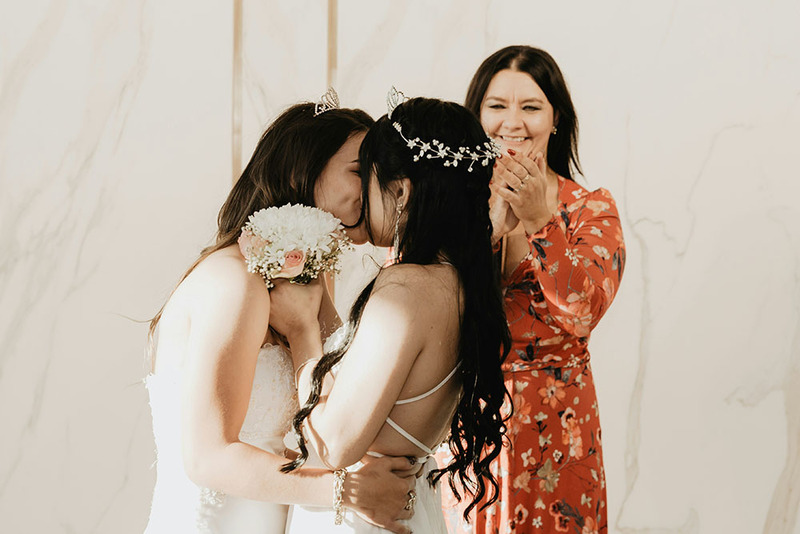
Become an ordained minister online with American Marriage Ministries and officiate wedding for friends and relatives. (Photo: Sofia Hernandez / Unsplash)


Choose Your Officiant with our "Will You Marry Us?" Gift Package.

Our premiere package contains everyting you need to officiate like a pro.
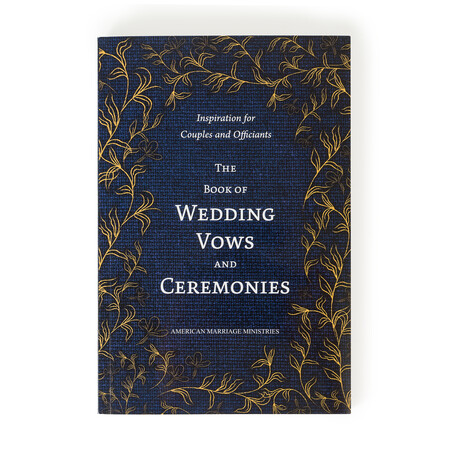
Timeless scripts and heartfelt vow inspiration to bring life to your ceremony.
Learn from the Pros to Officiate with Confidence!
POPULAR ARTICLES

Everything you need to know to officiate.

Need inspiration? Check out our free ceremony scripts!
Become a Wedding Officiant with Our Free Online Ordination!


