AMERICAN WEDDINGS BLOG
Stay up to date with the latest wedding ceremony trends, script writing inspiration, tips and advice for first-time officiants, and news that matters to couples and wedding ministers.
Stay up to date with the latest wedding ceremony trends, script writing inspiration, tips and advice for first-time officiants, and news that matters to couples and wedding ministers.
Published Friday, Mar. 27th, 2026 | Last updated Tuesday, Mar. 24th, 2026

Filling out a marriage certificate in Colorado: Step-by-step instructions for wedding officiants and self-uniting couples
Asked to officiate a Colorado wedding? Planning a "self solemnizing" marriage in Colorado? Whether you're a new wedding officiant or soon to be newlyweds, here’s everything you need to know about the CO marriage license and certificate process, including cost, waiting period, and – most importantly – tips on filling out a Colorado marriage certificate correctly the first time.
Wedding bells are ringing, so let’s dig in!
In this article: Colorado Marriage License & Certificate Topics
1. How to fill out a Colorado marriage license: For self-solemnizing couples and Wedding Officiants
2. Colorado Marriage License Examples
3. How to fix a mistake on a Colorado marriage license?
4. Does Colorado recognize online ordination for wedding officiants?
5. How much does it cost to get a marriage license in Colorado?
6. How long does it take to get a marriage license in Colorado? (Colorado marriage license waiting period)
7. How long is a marriage license good for in Colorado?
8. Do you need a marriage license to get married in Colorado?
9. Can you change your name using a Colorado marriage license?
10. How to get a copy of a marriage license in Colorado
11. Are marriage licenses public record in Colorado?
12. Can your dog sign your marriage license in Colorado?
In Colorado, a couple can legally perform their own marriage ceremony without a wedding officiant. This is called a “self solemnizing” or “self uniting” wedding ceremony, and is only allowed in a few states, including Colorado. In this case, you will sign your marriage license as both the “officiating party” and as parties to the marriage (“party 1” and “party 2”), along with one or two optional witnesses.
However, many couples enjoy the familiar tradition of having a wedding officiant lead the celebration – a trusted person guiding them through the wedding vow exchange and pronouncing them married. If you are an ordained officiant performing a wedding in Colorado, you will sign and print your name on the marriage license as the “officiating party,” along with your title (minister, pastor, etc.).
Friends and family members must be ordained before they can officiate a wedding in Colorado. Likewise, loved ones who are not ordained cannot sign a marriage license. Only couples themselves and authorized officiants can perform weddings in CO.
Couples must purchase a marriage license from a County Clerk and Recorder’s office on or before the wedding day and bring it with them to the ceremony.
|* ordination-button *|
More Info: Officiant Title on Marriage License
In some cases, you and your spouse will both sign in the space labeled “Signature of the Officiating Party,” and print your names legibly in the space labeled “Print Title of Officiating Party.” This is in addition to signing as parties to the marriage (“Party 1” and “Party 2”). (See the Arapahoe County marriage license example below.)
In a few cases, you and your spouse will both sign the space labeled "Signature of the Officiating Party," and then write "Self solemnize" in the space labeled "Print Title of Officiating Party." (See the Denver County marriage license example below.)
And in other cases, one spouse will sign their name in the space labeled “Signature of the Officiating Party,” and the other spouse will sign the space labeled “Print Title of Officiating Party.” Write “Party 1” or “Bride / Groom / Spouse” after your name. This is in addition to signing as parties to the marriage (“Party 1” and “Party 2”). (See the Eagle County marriage license example below.)
CO Marriage License vs Marriage Certificate: What's the Difference?
In Colorado, your marriage license and marriage certificate are two sections of the same, single document. The top portion (the license) is filled out when you apply at the clerk’s office. The bottom portion (the certificate) is filled out after the wedding ceremony by the couple, wedding officiant (if present), and optional witnesses. Many people simply refer to the entire document as a "marriage license." You'll return the full document to the clerk’s office after the ceremony, and receive a certified copy for your records.
We reached out to multiple county clerk and recorder offices for current examples of Colorado marriage licenses. These sample licenses are annotated to show you exactly how to fill them out, and demonstrate the differences between counties. We suggest you review the instructions provided by the clerk's office closely, as these instructions will vary by county.
Notice in this example that the Adams County Clerk instructs couples to sign the license using their married name (their intended name following the ceremony), as shown on the sample license they provided below. This is not the case in every county however, where couples may be instructed to sign using their current (or maiden) name. Adams County also requires both partners to sign the line labeled "officiating party" when self-solemnizing their marriage.
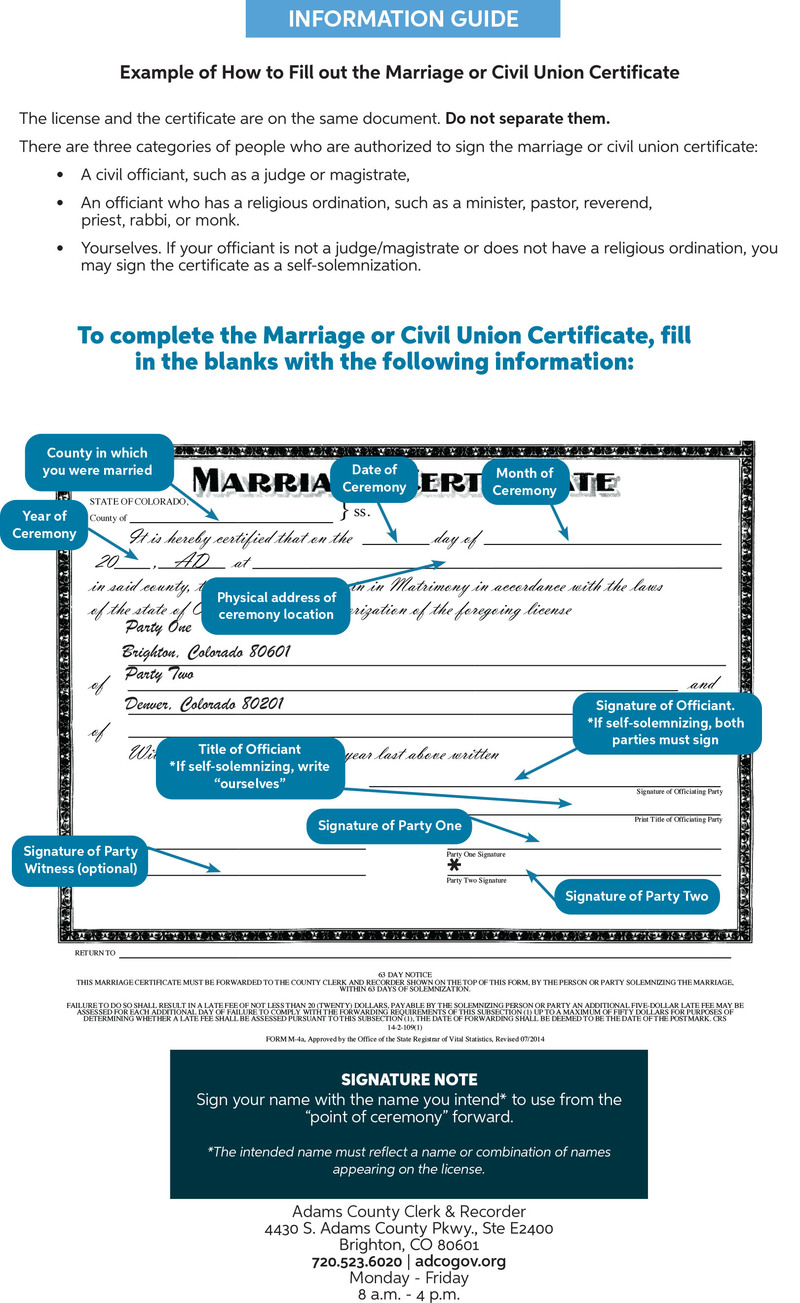
Above: Marriage License sample from Adams County, CO
Notice in this Denver City & County marriage license (below) that the couple signs with their current legal names, as they appear on their government IDs (not their intended married name). When performing your own wedding using a Denver marriage license, both parties sign as officiants, then write "self solemnize" on the line labeled "Title of Officiating Party."
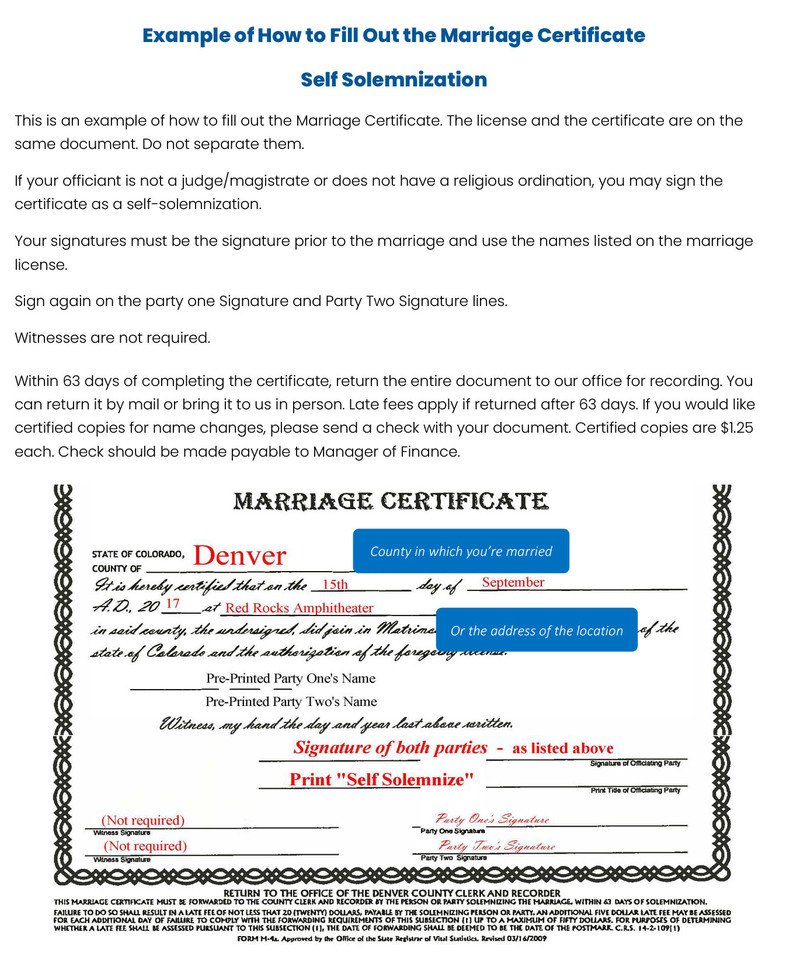
(Above: Denver marriage license for self solemnization)
Notice in this sample Denver marriage license (below) that "Officiant" is not an acceptable title to use when signing. If you're an ordained minister with AMM, write "Minister" as your official title.
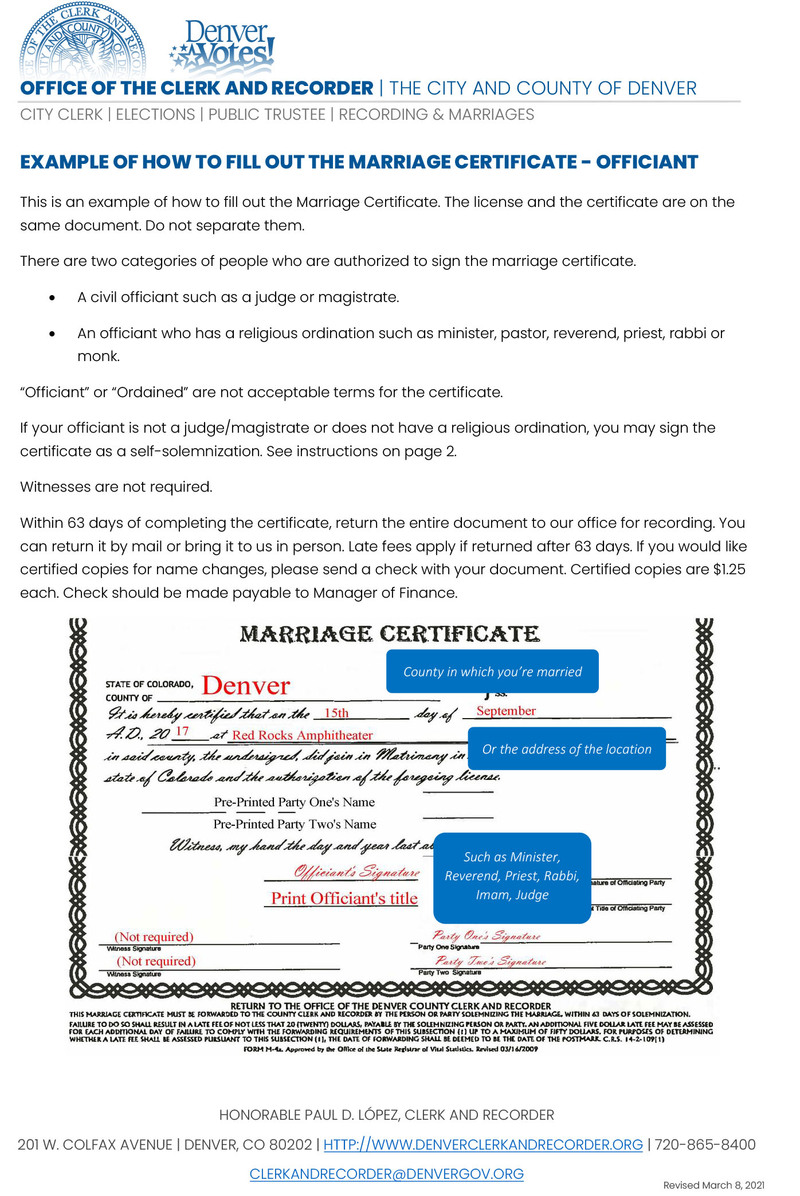
(Above: Denver marriage license with wedding officiant signature)
Notice in this sample marriage license from Arapahoe County that City and State must be included in your venue details (other counties may only require the name of the venue). Couples who self-unite are instructed to sign and print both names on the spaces labeled for an officiant, as well as signing as parties to the marriage.
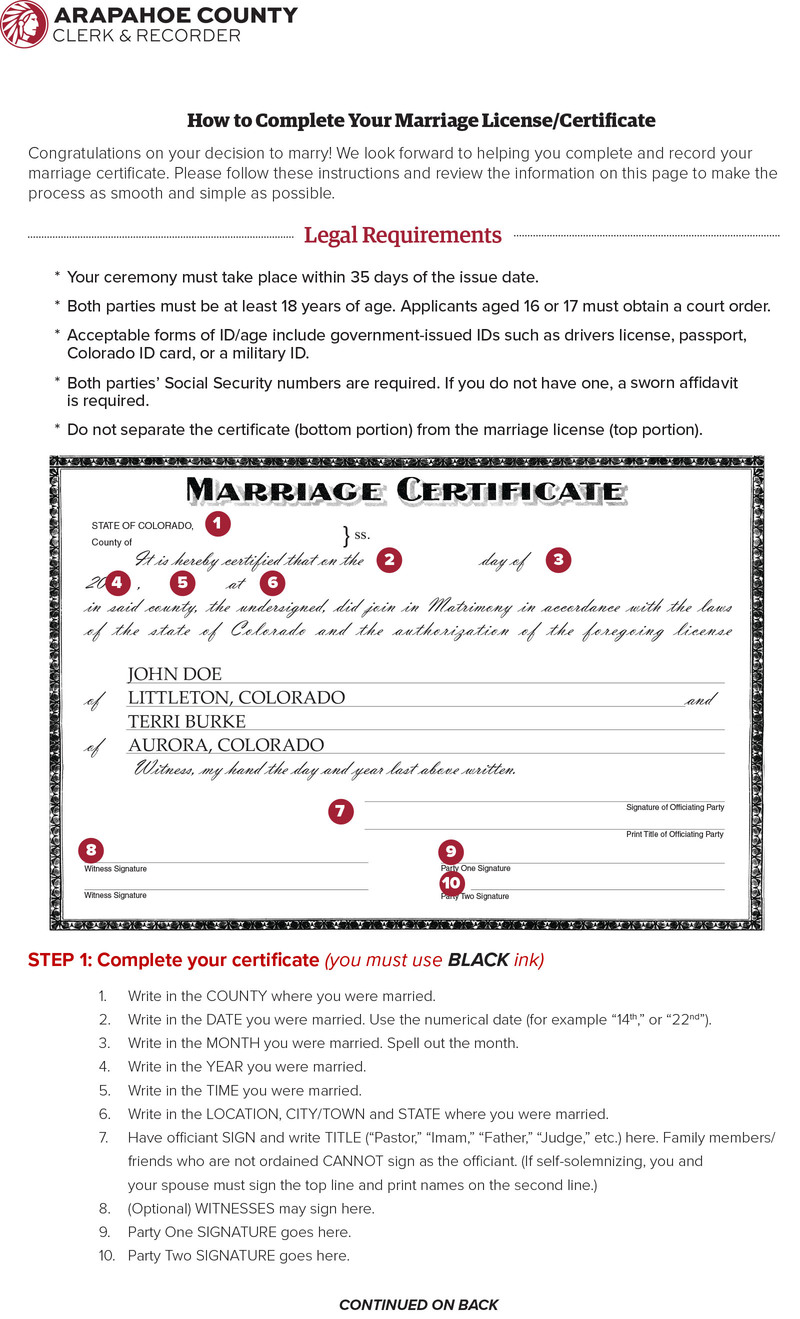
(Above: Sample marriage license from Arapahoe County, CO)
Notice in this sample Eagle County marriage license that couples who self solemnize will each sign on a separate line (labeled for officiants), as well as signing as party to the marriage; couples do not need to print their names on this license. These instructions also clarify that you do not need to write the time of your ceremony on your license, only the date and venue location.
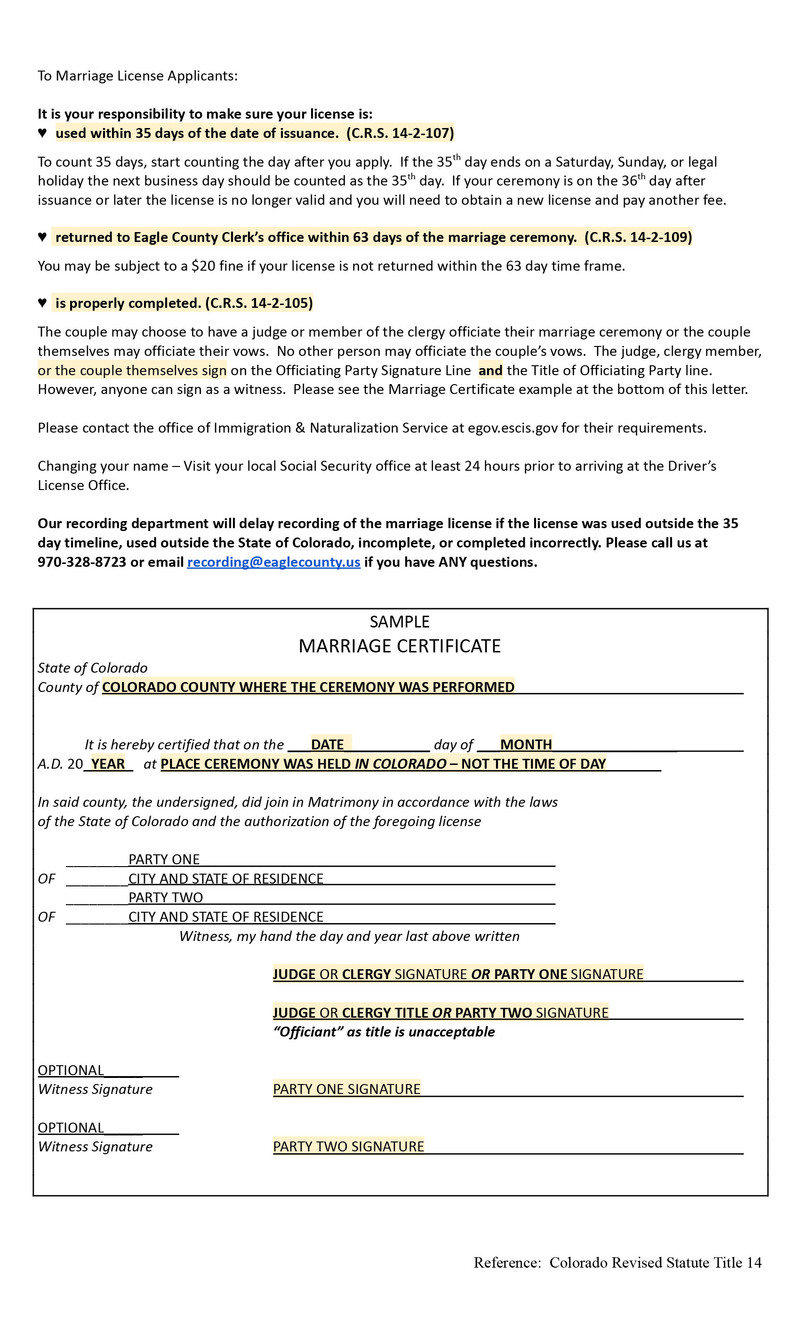
(Above: Sample marriage license from Eagle County, CO)
Advice from the County Clerk’s Office on providing proof of marriage:
“Do not give the original license out as proof of marriage. [The Clerk / Recorder] cannot recreate the original. Give the certified copies out. They are as good as the original and can be recreated at any time. Do not separate the certified cover letter from the copy of the marriage license.” (via Routt County Clerk)
If you make a mistake while filling out the marriage license – such as a misspelled name, signing the wrong line, or writing the wrong location – contact the county clerk’s office that issued the license for specific instructions on what to do next. In some cases, a clean replacement license might be needed to fix the error. Never use white-out or corrective tape on your marriage license, as this could invalidate the document.
Often, you will be able to pay a small fee (around $10-$20) to correct any errors, so don’t panic!
Yes, ministers who are ordained online through a reputable and recognized church, including American Marriage Ministries, can officiate weddings in Colorado and sign your marriage license.
|* custom-button, "https://theamm.org/weddings-by-state/colorado/get-ordained", "GET ORDAINED IN COLORADO" *|
However, not all online-ordained ministers are legally qualified to perform marriages in all states. If your officiant is ordained online with a church other than American Marriage Ministries, it’s important to verify their minister credentials before they perform your wedding ceremony:
Marriage license prices may vary slightly by county, and sometimes increase to keep up with state budget costs. For the most-current Colorado marriage license cost, click the link below, or contact your local clerk’s office:
The amount of time you spend in the clerk’s office will vary depending on where you apply. But because there’s no waiting period to marry in Colorado, you use your license immediately – the same day it’s issued.
From the Eagle County Clerk & Recorder’s Office in Colorado: “It is [the couple’s] responsibility to make sure your license is used within 35 days of the date of issuance…To count 35 days, start counting the day after you apply. If the 35th day ends on a Saturday, Sunday, or legal holiday, the next business day should be counted as the 35th day. If your ceremony is on the 36th day after issuance or later the license is no longer valid and you will need to obtain a new license and pay another fee.”
How long a marriage license is valid in each state is called the “expiration period.” This is the number of days or months you have to use your license after it’s issued – your ceremony must take place within this timeframe. For more information on the current Colorado marriage license expiration period, click the link below:
Yes, you do need a marriage license to get married in Colorado – even if you are “self-solemnizing,” a.k.a. getting married without a wedding officiant. Your marriage license is the official record of your marriage, and must be filed with the County Clerk and Recorder’s Office after your ceremony or signing celebration.
You can apply for your marriage license at any County Clerk’s office in Colorado, regardless of where in the state your wedding venue is located. You must return your license to this same office (the issuing office), so choose one that’s convenient! You don’t need to be a state resident to get married there.
For more helpful info on this process, read our Getting Married in Colorado State guide.
Maybe: This depends on the rules in the county where you apply for your license, and we strongly suggest following the issuing office’s specific instructions closely when it’s time to sign your license. Contact your clerk directly to ask about their marital name change guidelines.
According to some sources, including the Adams and Routt County Clerk Offices, a Colorado marriage license can be used to start a standard marital name change. The Routt County Clerk says:
“The two bottom right lines [on the marriage license] are for the couple to sign. This is the opportunity to legally change a name.
If you are wanting your new name to be First Middle Last, sign the license as First Middle Last. For example, Sally Ann Smith. Or, if you want your name to be four names or hyphenated, write it all out. For example, Sally Ann Ross-Smith Or Sally Ann Ross Smith.
If your signature is illegible, we ask you to sign your name on the line and then BELOW those two lines, write your name out in capital letters so the name is legible. Copies of the marriage license will be used for the certified copies [of name change] so it is helpful for the new name to be legible.
If you are not changing your name, sign the correct line just like you would any legal document. Legibility is not a concern in this case.”
However, most sources disagree with this advice, and state that you sign your marriage license using your pre-marriage name (maiden name), as it appears on your current government ID. For example, the Pitkin County Clerk Office and Jefferson County Clerk Office both clearly state that a marriage license must be signed with your current name and recorded before any marital name change can be made.
The bottom line: There is conflicting guidance on this topic. Ask your issuing clerk’s office if you can make a name change using your Colorado marriage license and follow their instructions precisely.
To order a certified copy of your Colorado marriage license after it’s filed with the clerk’s office, you'll need to contact the County Clerk's office where it was filed directly.
A “verification of marriage” document can be ordered online from the Colorado Department of Public Health and Environment. This isn’t an official certified copy, but it can be used in many cases to verify your marriage.
If you need a replacement copy of a marriage license before it’s been filed (if you lose your marriage license or make a mistake, for example), contact the issuing office directly for next steps.
If you need to correct or amend a filed Colorado marriage license, contact the County Clerk and Recorder’s Office where it was issued and returned for instructions. You may need to complete an affidavit, make a sworn statement, and pay a small fee.
Yes, marriage records are public records in Colorado. Marriage records that were registered before 1960 can be searched on the Colorado State Archives database, while more recent marriages can be found through the County Clerk’s Office where they were filed.
Unfortunately, no, you should not have your dog “sign” your marriage license.
The Denver, Colorado Office of the Clerk and Recorder explicitly states on their website that “Paw prints are not allowed on marriage licenses.” Although this is a cute idea, a dog paw print (or any pet print) on your official marriage certificate can invalidate the form and delay filing. Instead, have your pets “sign” as witnesses on an unofficial, decorative marriage certificate to honor the occasion.
Learn more: Can Your Pet Be a Wedding Witness? Not Exactly…


Choose Your Officiant with our "Will You Marry Us?" Gift Package.
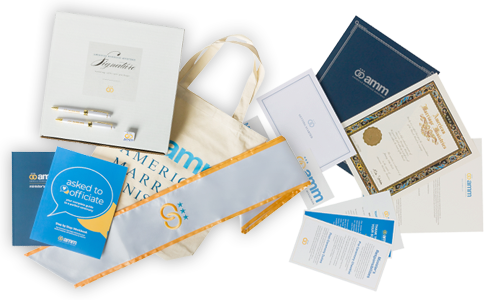
Our premiere package contains everyting you need to officiate like a pro.
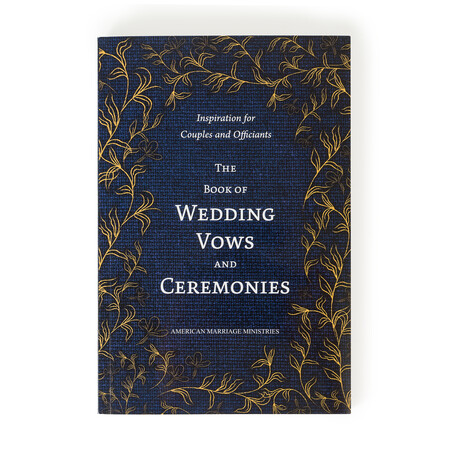
Timeless scripts and heartfelt vow inspiration to bring life to your ceremony.
Learn from the Pros to Officiate with Confidence!
POPULAR ARTICLES

Everything you need to know to officiate.

Need inspiration? Check out our free ceremony scripts!
Become a Wedding Officiant with Our Free Online Ordination!


